
Why Your Team’s "Motivation" Problem is Actually a Math Problem: Escaping the Hype Cycle
Stop trying to cheerlead your way to consistency. Motivation is a fleeting "sugar rush," but systems create lasting results. Discover why your team’s performance issues are actually "math" problems—and learn how to reduce friction, clarify roles, and design workflows that drive execution without constant nagging.
The Mind Lab Team
1/19/20265 min read
Why Your Team’s "Motivation" Problem is Actually a Math Problem: Escaping the Hype Cycle
We love a good pep talk.
There is something intoxicating about a rallying cry in a Monday morning all-hands meeting. The CEO stands up, vision casting for the quarter ahead. The slide deck is beautiful. The targets are ambitious. Everyone nods. The energy spikes. You look around the room and feel a genuine sense of relief—you feel like you are finally, truly on the same page.
But then, Wednesday hits.
The "new quarter energy" has evaporated. The inbox is full. The fires start burning. By Friday, the same mistakes are happening. The same deadlines are slipping. And you find yourself sitting in your office, staring at a slack message, thinking, "Why do I have to keep reminding them of this? We just talked about it."
This is the cycle of the "Chief Reminding Officer." It is exhausting, it is expensive, and it is entirely preventable.
Here is the hard truth that most leadership books won't tell you: You cannot cheerlead your way to consistency.
If you are constantly asking how to "motivate" your team to do the work, you are solving the wrong equation. You are trying to solve a structural problem with an emotional solution.
At The Mind Lab, we teach a simple principle: Execution over motivation.
If your strategy relies on your team being "excited" every single day, your strategy is broken. It’s time to stop looking at your people’s attitude and start looking at the math of your systems.
The Sugar Rush of Leadership
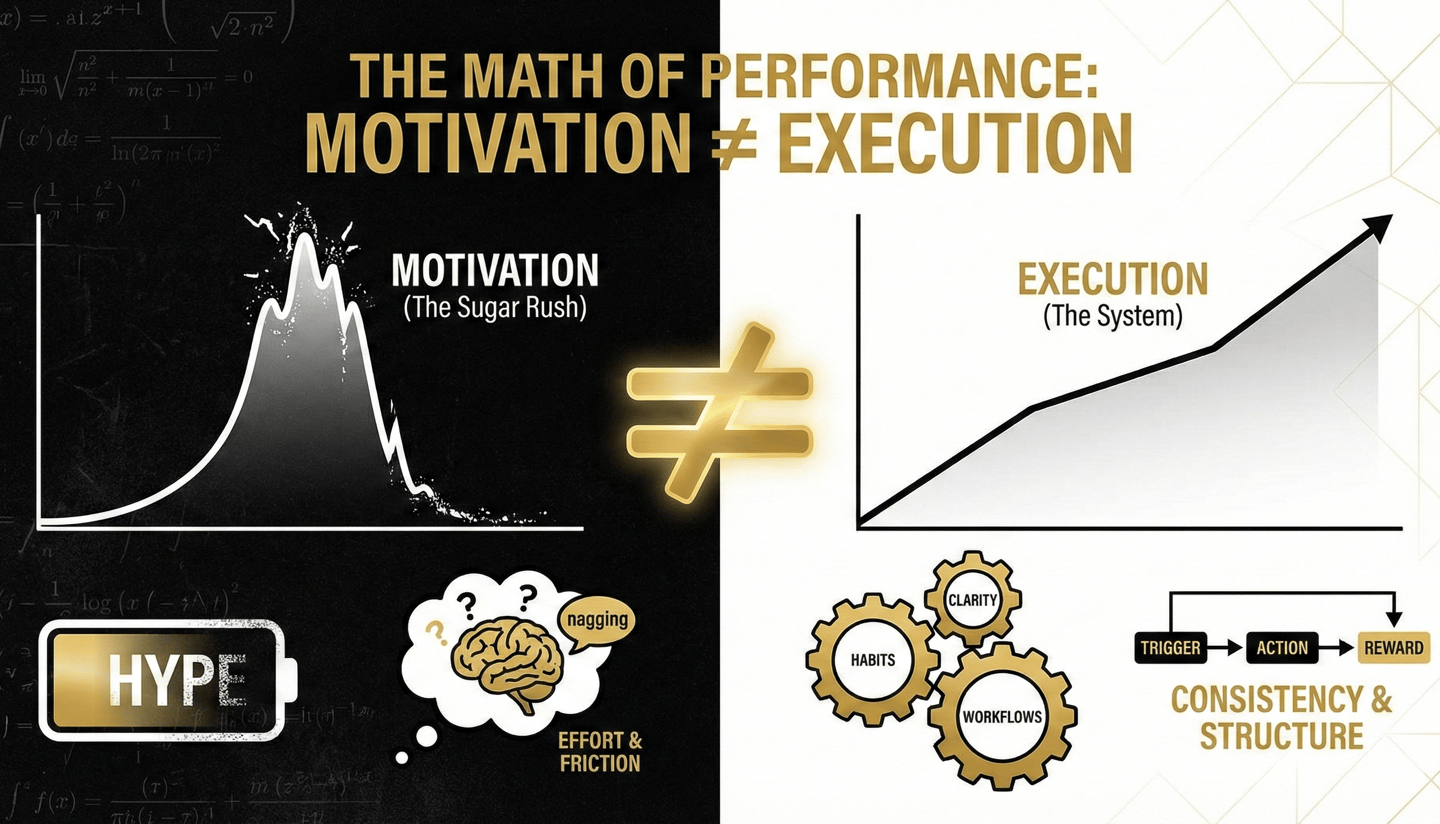
Motivation is real, but it is biological. It is a surge of dopamine. It is, by definition, a temporary state. Think of motivation like a sugar rush: It feels great for an hour, but it crashes fast.
When leaders rely on hype, speeches, and pressure to drive performance, they are essentially fueling a high-performance engine with sugar water. It might sputter forward for a mile, but it will eventually seize up.
The reality of human behavior is that we do not rise to the level of our goals; we fall to the level of our systems. When the pressure mounts and the "new year energy" fades, human beings default to their training. They default to the system.
If the system is confusing, execution breaks.
If the system is clear, the right actions happen even on the hard days.
Consistency comes from structure, not motivation.
The "Math" Problem: Friction vs. Willpower
Why do we call this a "math" problem? Because human behavior is a calculation of energy expenditure.
Every task you ask your team to do has a "friction cost."
Is the file hard to find? (+ Friction)
Is the decision-making authority unclear? (+ Friction)
Is the software slow? (+ Friction)
Your team members have a limited supply of "willpower units" every day. If the friction cost of doing the job the right way is higher than their available willpower, they will take the path of least resistance. They will cut corners. They will delay. They will wait to be told what to do.
You perceive this as "laziness" or "lack of drive." In reality, it is simply bad design.
Teams can’t rely on energy, pressure, or constant reminders to perform. You have to build the track for the train to run on.
If you want to swap the exhaustion of "nagging" for the peace of "execution," you need to address three specific variables in your organizational equation.
Variable 1: Ambiguity (The Silent Killer of Speed)
Nothing drains motivation faster than confusion.
In many organizations, roles are defined loosely. We use phrases like, "We are all responsible for revenue," or "The team owns this project."
While that sounds collaborative, in practice, it is paralyzing. "We are all responsible" usually means "No one is responsible."
When two people "kind of" own a task, neither owns it. They enter a polite standoff, waiting for the other person to take the lead. Days pass. The deadline slips. And when you ask why, you get the shrug.
The Fix: Kill the ambiguity. Undefined roles create confusion. You must assign clear decision rights. Your team needs to know exactly where their authority begins and ends. When people know they are the sole owner of an outcome, they don't wait for permission—they act.
Variable 2: Friction (Designing for Laziness)
We design systems that make the right actions easier. This is the golden rule of operations.
If filing a weekly report takes 15 clicks, requires a login to a slow portal, and involves manual data entry, your sales team will not do it until you threaten them.
Is that because they are bad employees? No. It’s because the "math" doesn't work. The effort outweighs the perceived value.
Good leaders are architects. They look at a process and ask, "How can I remove steps?"
If it takes 10 clicks, can we do it in 2?
If it requires approval, can we pre-approve it?
If it requires memory, can we make a checklist?
Lower the friction. If doing the right thing becomes the easiest path, people won't need "motivation" to do it.
Variable 3: Habits over Hype
We often confuse "intensity" with "consistency."
Intensity is pulling an all-nighter to finish a deck. Consistency is having a workflow that ensures the deck is done three days early, every time.
Habits form when processes are clear. You cannot hype your way into a habit. You build a habit by creating a trigger, an action, and a reward—and by making that loop repeatable.
Don't ask your team for "more effort." That is a vague request that leads to burnout. Ask for "better routine."
Instead of: "We need to communicate better!" (Hype)
Try: "We will have a 15-minute stand-up at 9:00 AM daily to unblock bottlenecks." (Habit)
Advice sounds good. But systems change behavior.
The Transformation: From Cheerleader to Architect
When you stop trying to be the source of all energy in your company, something amazing happens. You stop being the bottleneck.
If you rely on motivation, the company only moves as fast as you can push it. If you rely on systems, the company can move faster than you.
Plans fail without structure and ownership. Good intentions are not enough. You have to be willing to do the unsexy work of documenting processes, defining roles, and removing obstacles.
This is what we do at The Mind Lab. We help leaders realize that their "people problems" are usually "process problems" in disguise. We help you transition from a culture of heroics (where people save the day at the last minute) to a culture of excellence (where the day doesn't need saving).
Your Action Plan
So, how do you solve the math problem?
Identify the Nag: Write down the one task, report, or behavior you have to constantly "nag" your team about. The thing that makes you roll your eyes every Friday.
Stop Nagging: Decide right now that you will not mention it again until you have fixed the system.
The Friction Audit: Sit down with the person responsible for that task. Do not scold them. Ask them this specific question: "What in our current system makes this task hard to do?"
Do they lack the data?
Is the software clunky?
Are they waiting on someone else?
Re-Engineer: Remove one barrier. Just one. Make the "math" easier.
Fix the friction, and watch the motivation take care of itself.
Ready to Stop Guessing and Start Scaling?
If you are tired of the Monday-morning hype cycle and want to build a business that runs on reliable systems, you don't have to start from scratch.
1. Download the FREE OD Mini-Map Most business challenges aren’t random. They follow patterns. The OD Mini-Map is your free, step-by-step guide to diagnosing your biggest business challenges and creating lasting change from within. It breaks organizational development into clear, practical steps so you can diagnose what’s really happening and take action with confidence.
2. Book a Free Consultation Sometimes you need an outside eye to spot the friction points. At The Mind Lab, we specialize in helping leadership teams move from overwhelm to clarity. Let’s discuss how we can help you build a culture of execution.