
Why Sales Problems Actually Start Inside Your Business
When sales numbers drop, the instinct is often to push the sales team harder. But in many small businesses, the problem isn't a lack of effort—it's internal operational chaos. Unclear messaging and fumbled handoffs between teams create a leaky pipeline that no amount of hustle can fix. This blog post explains why sales problems are often systemic, not individual, and how aligning your internal operations is the only way to build a predictable, scalable revenue machine.
3/4/20264 min read
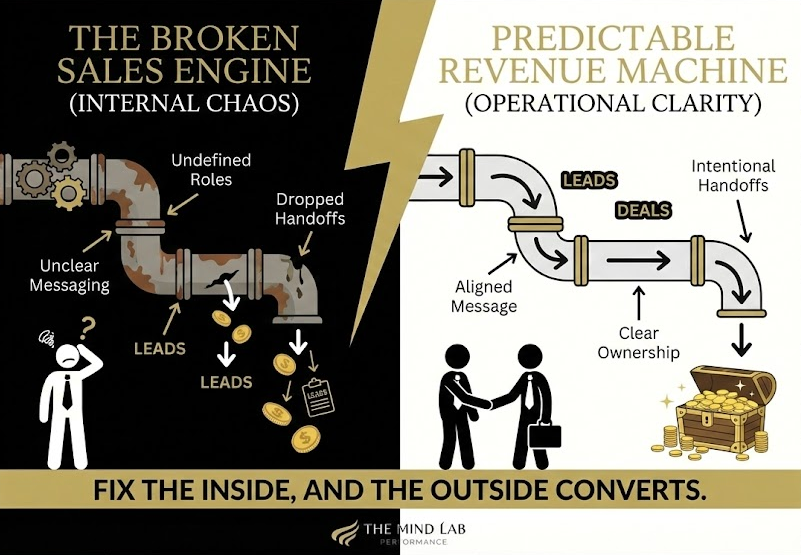
It’s the end of the month, and the numbers are staring back at you in bright, glaring red. You are missing your revenue target. Again.
Panic sets in. You do what almost every founder does when sales slow down: your instinct is to push harder. You buy new closing scripts, schedule an emergency sales training seminar, and apply more pressure to your team to "hit the phones and hustle".
But a week goes by, and nothing changes. Your team is just sweatier, more stressed, and still not closing.
Here is the hard truth we deliver to founders at The Mind Lab: In many small and growing businesses, sales problems don't start with effort or skill. They start with what is happening inside the organization.
Revenue suffers when clarity breaks down behind the scenes. Let's look at why your pipeline is actually drying up, and how treating sales as an operational system—rather than a mystical art form based on charisma—can fix it.
The Silent Killers of Your Sales Pipeline
When we audit struggling sales teams, we rarely find a group of lazy people. What we find is a massive amount of structural friction. Sales performance reflects internal alignment far more than effort.
Here are the two biggest internal leaks draining your revenue:
1. The Messaging Identity Crisis Unclear messaging creates inconsistent sales. If you ask three different people on your team what your company does and who you serve, do you get three different answers? Probably.
When teams don't share a clear message, sales conversations vary wildly. Prospects end up hearing different value propositions depending on who they speak to on your team. This creates massive doubt in the buyer's mind. When the message is unclear internally, it shows up as confusion externally. And confused prospects don't buy.
2. The Handoff Black Hole Sales breaks at the handoff points. Your marketing team generates a lead, but it takes two days to get it to a sales rep. The sales rep has a great call, but doesn't pass the notes to the account manager.
Vague roles create dropped handoffs, and undefined ownership causes follow-ups to stall. Leads fall through the cracks when ownership is unclear. When this happens, accountability blurs and trust erodes. Prospects feel that friction immediately. If you look disorganized before they even pay you, they are going to take their business elsewhere.
The Agency That Thought They Needed "Better Closers"
We recently worked with a mid-sized B2B consulting firm. The CEO was incredibly frustrated because their close rate had plummeted. He called us in, convinced he needed us to fire his sales team and hire "absolute sharks" who could close deals.
Before we let him fire anyone, we mapped out their internal systems. What we found was a disaster.
The marketing team was running ads promising a cheap, automated solution, but the sales team was pitching a high-ticket, bespoke service. Prospects were immediately alienated on the first call. Worse, when a prospect did say yes, there was no clear process for who sent the contract. Contracts were sitting in an email draft folder for up to 5 days while the team argued over who was supposed to hit "send."
They didn't have a closing problem. They had a systems problem.
We didn't teach them a single new sales script. Instead, we aligned marketing and sales on one singular message, and we built a rigid Standard Operating Procedure (SOP) for who owned the prospect at every single stage of the pipeline. Within 45 days, their close rate doubled. The team didn't work any harder; the system just stopped getting in their way.
How to Fix Your Sales Engine
Sales is a system, not just a skill. To fix your revenue, you have to fix the internal architecture of your business. Here is how you do it:
Action Item 1: Unify the Message You need to clarify who you serve and why you matter. Get your leadership, sales, and marketing teams into a room and align them on core messaging. You must clearly define what problems you solve, and equally important, what problems you don't solve.
Action Item 2: Define Ownership at Every Step You must define clear ownership at each stage of the sales process. Walk through your pipeline and clarify exactly who owns the relationship at every handoff. Set rigid expectations for timing, follow-up, and communication. Clear roles and handoffs protect momentum and revenue.
Action Item 3: Audit the Buyer's Journey Sit down today and ask yourself these hard questions: Where does confusion show up most in your sales process? Who owns each step from first contact to close? What assumptions are prospects forced to navigate when dealing with your team?
Sales improves when internal clarity improves. When teams share a clear message, understand their role in the process, and know who owns each step, revenue becomes more predictable and far less stressful.
When messaging is aligned, roles are clear, and handoffs are designed intentionally, sales becomes calmer, more consistent, and more predictable.
Your Next Steps
Step 1: Let’s Talk Strategy Sometimes you need an outside perspective to spot the friction points you’ve become blind to. If your sales feel harder than they should, and you know internal chaos is costing you money, let's connect. At The Mind Lab, we help business owners and CEOs build the systems, culture, and sales strategies that create sustainable growth without burning out your best people.
Contact our team for a free consultation
Step 2: The 90-Day Operational Reset If your revenue is leaking and your team is exhausted from pushing harder on a broken system, it’s time to stop patching the holes and rebuild the machine. The 90-Day Operational Reset is our high-touch, intensive consulting engagement designed for founders who need to get out of the weeds. We will help you align your messaging, define your roles, and build the clear systems required to make your revenue predictable.