
Why Growth Feels Like Breaking: The Hidden Reason Small Businesses Struggle During Change
Blog post description.Growth doesn't break small businesses—a lack of structure does. Discover why teams struggle during change and how to build systems that scale without burnout.
TML Team
3/4/20264 min read
You finally hit that big revenue milestone. You signed that massive client, or you decided to pivot your services to capture a new market. This is the moment you’ve been hustling for. You should be popping champagne.
Instead, you’re popping Advil.
You’re working 15-hour days, your inbox is a warzone, and your team looks like they haven’t slept since Tuesday. Deadlines are slipping, tempers are short, and you find yourself wondering: “If we are doing so well, why does it feel like everything is falling apart?”
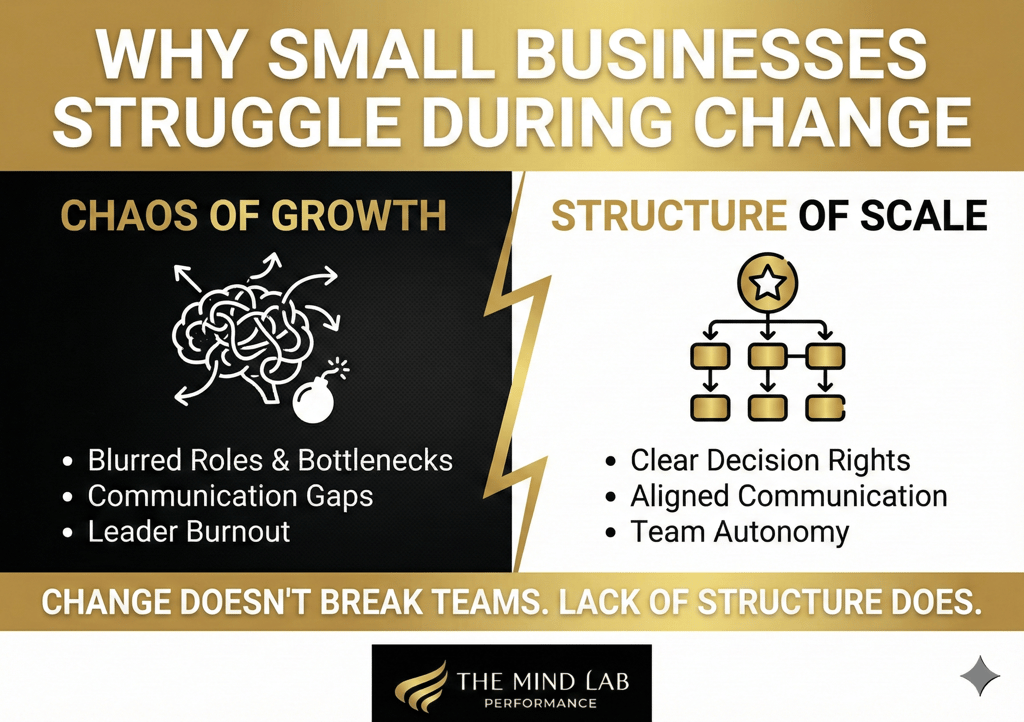
Here is the hard truth we tell our clients at The Mind Lab: Change doesn't break teams. A lack of structure does.
Change is uniquely painful in small businesses because everything is so close to the surface. In a massive corporation, a pivot takes two years and gets filtered through ten layers of middle management. In a small business, a pivot happens on a Thursday, and by Friday morning, everyone feels the impact.
Growth, pivots, and transitions act like a blacklight in a cheap hotel room—they expose absolutely every crack in your operational foundation.
Let’s break down exactly why your business is struggling with change, what is actually breaking behind the scenes, and how to fix it without burning out your best people.
Pain Point 1: The Duct-Tape Structure Finally Snaps
What got you here won't get you there. It’s a cliché because it’s true. The scrappy, "figure it out on the fly" energy that successfully launched your business is the exact same energy that will destroy it when you try to scale.
During periods of rapid change, the first thing to be exposed is your weak structure. What worked flawlessly just six months ago suddenly stops working mid-growth.
Here is what that looks like on the ground:
The "Wearer of Many Hats" becomes a bottleneck: Roles begin to blur as new responsibilities shift. Suddenly, your marketing person is doing customer service, your operations manager is doing sales, and no one actually knows who owns what.
The Decision Traffic Jam: Because roles are blurry, nobody feels empowered to make a call. Decisions either slow down to a crawl, or they constantly escalate straight to you, the founder.
The Founder Trap: Old processes simply don't fit your new demands. When the system fails, who steps in to catch the falling plates? You do. Leaders end up absorbing the work the system can’t handle.
If your company’s entire Standard Operating Procedure is essentially just “Go ask Sarah,” you don’t have an operational structure. You have a hostage situation. During change, your structure will either stabilize the team, or it will become the ultimate stress point.
Pain Point 2: The Communication Black Hole
When things get busy, communication is usually the first casualty. And when clarity goes missing, uncertainty grows to take its place.
You might think you are communicating well because you mentioned the new direction in a Tuesday morning meeting. But by Thursday, the message has become completely inconsistent. Without a central source of truth, teams start filling in the operational gaps with guesswork.
If you aren't over-communicating the who, what, when, and why, your team will make assumptions to replace the lack of alignment. And assumptions in business are incredibly expensive.
This leaves you, the leader, exhausted because you feel like a broken record, constantly repeating the same explanations to different people all week long.
Pain Point 3: The Invisible Emotional Tax
This is the variable almost every ambitious founder misses. People carry far more than just new tasks during a transition. They carry an invisible emotional load.
When you introduce new software, change a reporting structure, or shift a target, you are disrupting their routine. When expectations are unclear, their daily stress skyrockets. Suddenly, your top performers are paralyzed by a fear of making mistakes, which slows down their decision-making even further.
And who do they bring that anxiety to? You.
As a leader during a transition, you aren't just managing the work—you end up managing emotions just as much. You become an unlicensed therapist for a team whose energy is dropping rapidly because they lack clear direction. Ignoring this emotional load during a period of change will quietly erode your team's performance and their trust in you.
The Solution: Change Needs Clarity, Not Control
When chaos hits, the natural instinct of a high-achieving founder is to grip the steering wheel tighter. You try to micromanage your way out of the mess. You ask to be cc’d on every email. You demand to approve every minor choice.
Stop. Change needs clarity, not control.
You cannot hustle your way out of a structural deficit. The right systems are what actually help teams adapt to new realities without burning out.
Here is how you move from firefighting to architecting your growth:
Action Item 1: Re-Draw the Boundaries If responsibilities have shifted, you need to literally write down the new rules of engagement. Who makes the final call on X? Who owns the outcome of Y? Structure creates stability. When people know exactly where their sandbox ends, they can start playing in it confidently.
Action Item 2: Build a Communication Cadence Clear communication reduces anxiety and keeps everyone moving forward together. Stop relying on hallway conversations or fragmented Slack messages. Implement a strict, weekly operational meeting where the sole purpose is to clarify priorities, announce changes, and align the team. Communication builds confidence.
Action Item 3: Validate the Friction Don't ignore the emotional strain. Acknowledge to your team that things are messy right now. Tell them, "We are outgrowing our old systems, and I know that is frustrating. But we are actively building new ones." That level of transparency immediately reduces the emotional strain.
Growth is supposed to be challenging, but it shouldn't feel like a daily crisis. If you are ready to stop patching the leaks and start building a ship that can actually handle deep waters, it’s time to take action.
Your Next Steps
Step 1: Download the Free OD Mini-Map We’ve put together a step-by-step diagnostic guide to help you uncover the hidden friction slowing your business down. The OD Mini-Map breaks complex organizational development into simple, actionable steps so you can regain control of your operations. It is designed to move you out of the weeds and into clarity, without the need for bloated corporate frameworks.
👉 Download your FREE OD Mini-Map here
Step 2: Let’s Talk Strategy Sometimes, you are just too close to the picture to see the frame. If you need an outside, expert perspective to identify the structural bottlenecks you’ve become blind to, we are here to help. At The Mind Lab, we help driven founders rebuild their systems, align their culture, and construct the operational machines that fuel sustainable growth.
👉 Contact our team for a free consultation
Let’s make this the year you stop just "hustling" through the chaos, and start intentionally scaling.