The Most Dangerous Lie in Business: "If We're Busy, We're Winning"
Sweat is not a KPI. Many teams are working hard every day but moving in different directions. Read on to learn why "shared direction" is the only metric that matters—and how to stop rewarding noise and start rewarding progress.
2/25/20264 min read
Let’s pour a fresh cup of coffee and get real for a minute.
If we asked you how your week is going, what would you say?
Likely some variation of: “Man, it’s crazy. Back-to-back meetings. Emails are piling up. We are just swamped.”
You say it with a sigh, but let’s be honest—there is a tiny part of you that wears that exhaustion like a badge of honor. In our culture, "busy" is code for "important." It’s code for "demand is high." It’s code for "we are crushing it."
But here is the hard truth we have to deliver to clients constantly: Sweat is not a KPI.
We see teams every day that are absolutely red-lining. They are working late. They are skipping lunch. The Slack channels are buzzing at 9:00 PM.
But when you look at the actual needle—revenue, profit, customer retention—it hasn't moved an inch.
Why?
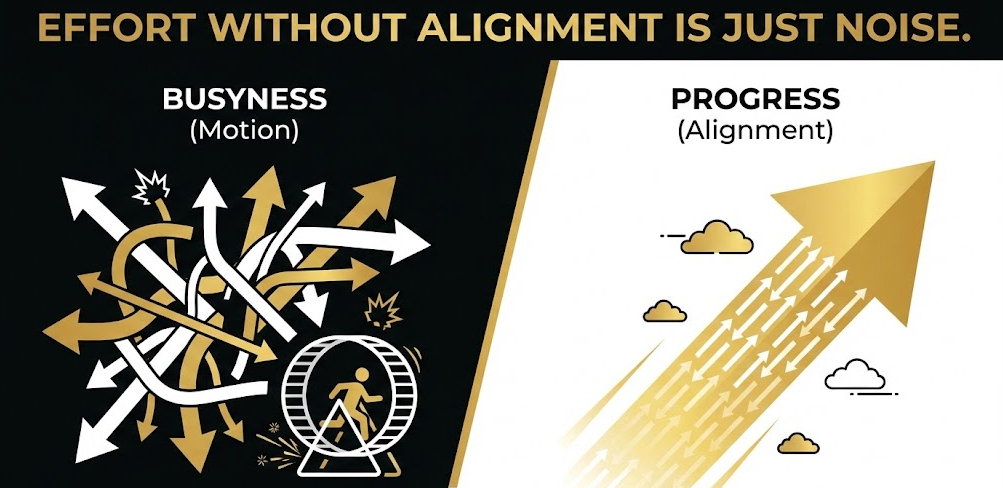
Because busy doesn't mean aligned.
The Treadmill Trap
Imagine a rowing team.
If everyone in the boat is rowing as hard as they physically can, but half the team is rowing north and the other half is rowing south, what happens?
There is a lot of splashing. There is a lot of grunting. There is a massive expenditure of caloric energy.
But the boat is sitting still.
This is exactly what is happening in most scaling companies.
Many teams are working hard every day, but they are moving in different directions. Marketing is chasing brand awareness while Sales is chasing quick closings. Product is building for the future while Customer Support is drowning in today’s bugs.
Activity increases, but priorities compete.
The result isn't growth. The result is noise.
The Symptoms of "Active Inertia"
We call this state "Active Inertia." It’s the feeling of running 100mph on a treadmill. You are exhausted, but the scenery never changes.
How do you know if your company is suffering from this? Here are the symptoms we look for during our initial audit:
1. The "Whac-A-Mole" Management Style
Decisions feel reactive. Your leadership meetings are spent putting out the fire of the week rather than building the strategy for the year. You aren't steering the ship; you are just bailing water.
2. The "Everything is a Priority" Memo
If you have 15 top priorities, you have 0 top priorities. When everything is important, nothing is important. Without a shared direction, effort spreads instead of compounds. Your resources are spread so thin that no single project gets the energy it needs to actually cross the finish line.
3. The "Zombie Projects"
These are the initiatives that never quite die but never quite launch. They just shuffle along, eating up budget and brainpower, because no one has the alignment to kill them or the focus to finish them.
Why We Love Being Busy (And Why We Must Stop)
Why do smart leaders let this happen?
Because "busy" feels safe.
When you are busy, you don't have time to ask the scary questions like, "Is this actually working?" or "Does the market even want this?"
Alignment is harder than busyness.
Alignment requires you to say "No."
Alignment requires you to look a passionate team member in the eye and say, "That’s a great idea, but we aren't doing it right now."
But here is the equation you need to tape to your monitor:
Alignment turns effort into progress.
Without it, busyness creates noise, not results.
How to Stop Spinning and Start Scaling
If you are tired of the noise, you have to stop rewarding motion and start rewarding momentum. Here is how we help clients break the "busy" addiction.
Action Item 1: The ruthless Audit of "Why"
Look at your calendar for next week. Look at the projects on your whiteboard.
For every single item, ask: "If we did this perfectly, would it matter?"
If the answer is "I don't know" or "Maybe," kill it.
If your team had to decide what not to work on this week, would they all make the same choice?. If not, you have an alignment gap.
Action Item 2: Define "True North"
You need a shared direction so that effort compounds.
Sit your leadership team down and define the One Thing. Not the five things. The One Thing that must happen this quarter for you to call it a success.
Once that is defined, every other decision becomes a binary choice: Does this help us achieve the One Thing?
Yes = Do it.
No = Don't do it.
Action Item 3: Celebrate the "No"
Create a culture where saying "no" to distraction is celebrated as much as saying "yes" to innovation.
When a manager says, "I’m going to skip this meeting because I need to focus on the launch," don't call them uncooperative. Call them focused.
The Calm After the Storm
When you finally get aligned, something weird happens.
The office gets quieter. The slack notifications slow down. The frantic energy dissipates.
At first, it feels like you’ve lost your edge. You might panic and think, "Are we working hard enough?"
But then you look at the numbers. And they are up.
You look at the team. And they are happy.
That is the power of clarity.
Stop trying to do more. Start trying to do one thing together.
Ready to Turn Down the Noise?
If you read this and realized that your team is running a marathon in twelve different directions, it’s time to pause. You don't need to work harder; you need to aim better.
Step 1: Download the Free OD Mini-Map
We have created a free, step-by-step guide to help you diagnose what is really happening in your business—beyond the "busy work."
The OD Mini-Map breaks organizational development into clear, practical steps so you can take action with confidence. It is designed to help you move from overwhelm to clarity without needing complex frameworks or expensive retainers.
👉 Download your FREE OD Mini-Map here
Step 2: Let’s Talk
Sometimes you are too deep in the weeds to see the path out. You need an outside perspective to spot the friction points you’ve become blind to. At The Mind Lab, we help business owners and CEOs build the systems, culture, and sales strategies that create sustainable growth.
👉 Contact our team for a free consultation
Let’s make this the year you stop just "growing" and start scaling.