The Dangerous Myth of "Good Chaos": Why Friction is Killing Your Growth Strategy (And How to Fix It)
Is your business growing or just chaotic? Discover why "hustle" culture leads to burnout and learn The Mind Lab's 5-step framework to replace reactive panic with structured execution.
The Mind Lab Team
1/9/20265 min read
The Dangerous Myth of "Good Chaos": Why Friction is Killing Your Growth Strategy (And How to Fix It)
There is a pervasive, dangerous myth in the modern business world. It’s a story we tell ourselves in boardrooms and slack channels to make the stress feel worthwhile. The myth goes like this:
"If it feels chaotic, it must mean we’re growing."
We wear our stress like a badge of honor. We treat 12-hour days, constant fire-fighting, and a calendar double-booked with frantic meetings as proof of our importance. We tell ourselves that the late nights are just "part of the hustle." We convince our teams that this survival mode is temporary—just a necessary phase of scaling up.
But here is the hard truth that most consultants won't tell you, but we at The Mind Lab see every day:
Chaos isn't a sign of speed. It’s a sign of friction.
If your team spent the last year running at 100mph but feeling like they were standing still, you don’t need to "motivate" them more. You don’t need a new mission statement, and you certainly don't need more pressure.
You need to clear the path. You need structure.
The High Cost of the "Hustle" Mentality
When a leadership team equates busyness with effectiveness, they unknowingly create a culture of burnout. We see brilliant teams burn out every day—not because the work is too hard, but because the structure is too soft.
When you tolerate chaos, you force your high-performers to use their limited energy navigating confusion instead of driving results. They spend their days asking:
"Who has the final say on this?"
"Which version of the file is the right one?"
"Why are we in this meeting again?"
This isn't growth. This is waste.
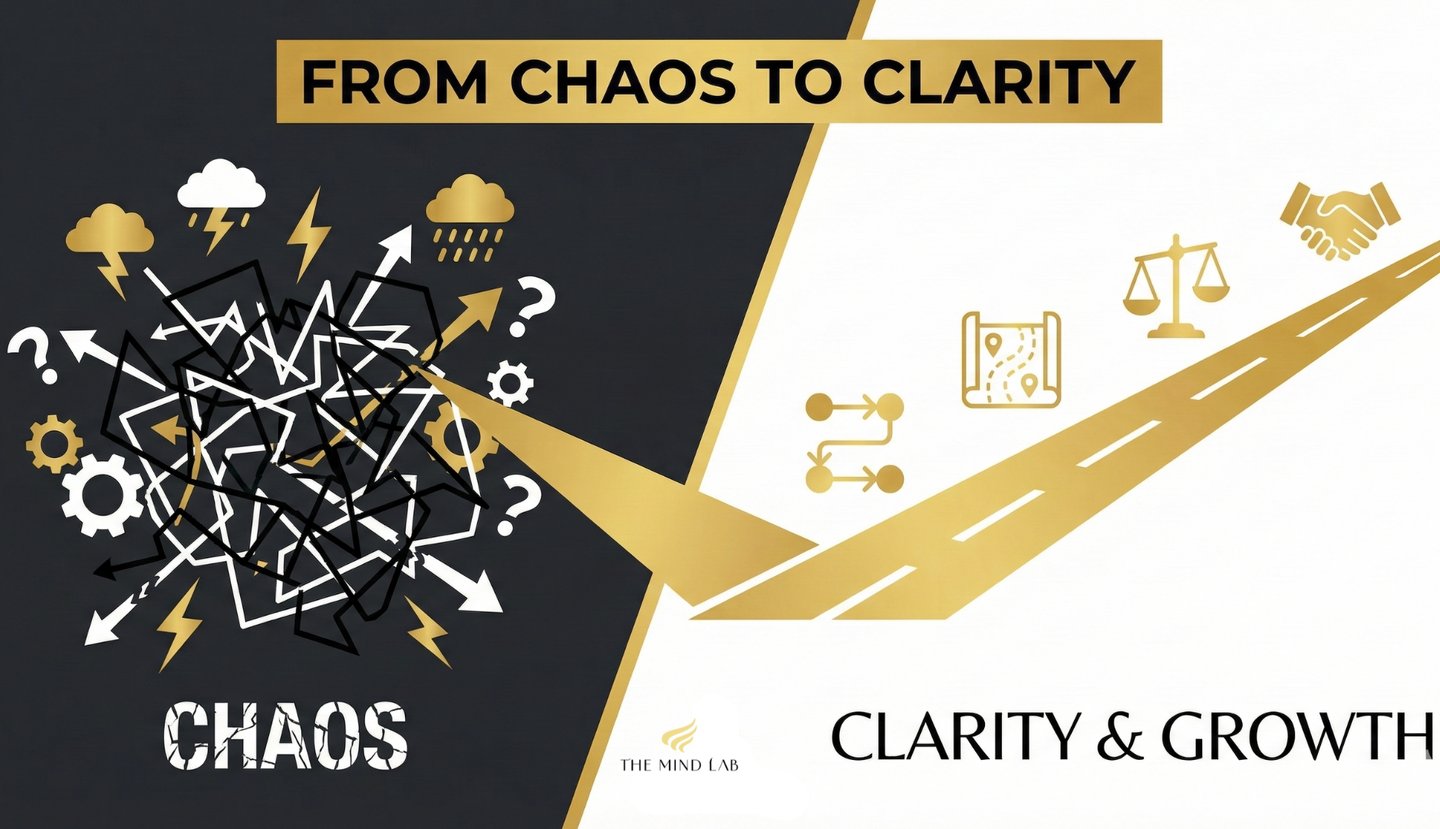
Chaos fades when structure improves. The goal of organizational development isn't to create bureaucratic red tape; it is to create the freedom to execute. Structure gives your team permission to work with confidence. It replaces anxiety with consistency. It turns "survival mode" into sustainable growth.
If you want this year to look different than the last, you have to stop rewarding "busy" and start rewarding "clarity."
Diagnosing the Chaos: Is It People or Systems?
When deadlines slip and quality drops, the knee-jerk reaction is often to blame the people. "We need better talent," or "They just don't want it bad enough."
But at The Mind Lab, we operate on a fundamental principle: Systems before people.
When performance drops, it’s tempting to blame motivation, attitude, or effort. But most performance issues are not people problems. They are signals that the system, expectations, or structure are unclear.
If you put a Ferrari on a dirt road full of potholes, it’s going to drive slowly. That’s not the car's fault; it’s the road's fault. Strong leaders look at the system before judging the person.
So, before you overhaul your team, you must overhaul the environment they work in.
5 Steps to Move from Chaos to Clarity
If last year felt chaotic, you cannot simply "hope" this year will be better. Hope is not a strategy. You need to strip your operations down to the studs and rebuild the foundation.
Here are five specific areas to audit in your business immediately, based on our proven framework for organizational health.
1. Simplify Workflows
Complexity is the enemy of execution. Over time, businesses accumulate "process debt"—steps and approvals added years ago for reasons no one remembers.
The Fix: Look at your core processes. If a task takes 10 steps, ask: "Can it be done in 3?". ruthlessly eliminate the "middle-man" steps that add wait time without adding value.
2. Reduce Unnecessary Tasks
Every organization has "zombie tasks"—reports that no one reads, meetings that have no agenda, and admin work that exists simply because "we’ve always done it that way".
The Fix: Audit your team's time. If an activity does not directly contribute to revenue, customer satisfaction, or employee retention, it is on the chopping block.
3. Clarify Ownership
This is the single biggest cause of operational drag. When we say, "We are all responsible for this," what the team hears is, "No one is responsible for this".
Ambiguity breeds inaction. When roles aren't clearly defined, your high performers step back because they don't want to step on toes, and your low performers hide in the confusion.
The Fix: Assign a single owner to every key outcome. No shared custody of metrics.
4. Improve Communication
Communication isn't just about talking more; it's about talking better. Are you transmitting signal, or just noise?
The Fix: Ensure that every request includes context. When people understand the request, the timeline, and the purpose, they can prioritize without guessing. Clear communication lowers stress and reduces confusion.
5. Focus on Execution, Not Perfection
Perfectionism is just procrastination in a suit. Many leaders delay launches or decisions because they are terrified of getting it wrong. But in business, speed of implementation often beats the quality of the plan.
The Fix: Instill a "Version One" mentality. Get it moving, get data, and iterate.
The Secret to Consistency: Habits Over Hype
You might be reading this and feeling a spark of motivation to change things. That’s great—but it’s not enough.
Motivation fades. Systems don’t..
Teams can’t rely on energy, pressure, or constant reminders to perform. If your strategy requires you to be the "Chief Cheerleader" every Monday morning just to get the team working, your strategy is fragile.
When the system is clear, the right actions happen even on the hard days. Sustainable performance improves when leaders fix the system that shapes behavior, not just the behavior itself.
Your Action Plan for the Week
Don’t let another year slip by in a blur of reactive panic. You can start clearing the chaos today.
Here are three immediate actions to take this week:
The Meeting Audit: Look at your team’s recurring meetings. Ask yourself: "If we stopped doing this tomorrow, would the business actually suffer?" If the answer is no (or "I'm not sure"), delete it.
The "Why" Test: Before sending your next delegation email, pause. Did you explain the purpose? Remember: Clear communication lowers stress and reduces confusion. Add the "Why" to every request this week.
The Ownership Check: Pick your company’s top 3 priorities for the quarter. Ask your leadership team to write down who owns each one. If the names don't match, you have an alignment problem.
Stop Guessing. Start Diagnosing.
Chaos is a choice. You can choose to continue the hustle, or you can choose to build the machine that makes the hustle unnecessary.
Most business challenges aren’t random. They follow patterns in how people, processes, and decisions are designed. But it’s hard to see the label when you’re inside the jar.
If you are ready to move from overwhelm to clarity, you don't have to do it alone.
Step 1: Download the Free OD Mini-Map
We have created a free, step-by-step guide to help you diagnose what is really happening in your business.
The OD Mini-Map breaks organizational development into clear, practical steps so you can take action with confidence. It is designed to help you move from overwhelm to clarity without needing complex frameworks.
Download your FREE OD Mini-Map here
Step 2: Let’s Talk
Sometimes you need an outside perspective to spot the friction points you’ve become blind to. At The Mind Lab, we help business owners and CEOs build the systems, culture, and sales strategies that create sustainable growth.
Contact our team for a free consultation
Let’s make this the year you stop just "growing" and start scaling.