
Strong Execution Starts with Clarity, Not Ambition: 5 Things to Check Before You Set New Goals
Strong execution starts with clarity, not ambition. Before you set your next big targets, run your team through this 5-point alignment checklist to ensure your structure can support your strategy. Learn why most breakdowns aren't about motivation, but about undefined roles, unclear communication, and friction in your systems.
The Mind Lab Team
1/15/20264 min read
Strong Execution Starts with Clarity, Not Ambition: 5 Things to Check Before You Set New Goals
Every leadership team loves the "Goal Setting" meeting.
The energy is high. The whiteboard is full of big numbers. The ambition is clear. You leave the room feeling energized, convinced that this is the quarter you finally crush that stretch target.
But fast forward six weeks.
The energy has faded. The "big goals" are being suffocated by the daily whirlwind of operations. Deadlines are slipping, and your team looks confused rather than driven.
What went wrong? You had the right ambition. You had the right people.
The problem isn't the goal. The problem is that the structure never caught up to the ambition.
At The Mind Lab, we see this pattern constantly. Leaders try to layer aggressive new targets on top of a broken foundation. They pour high-octane fuel (ambition) into an engine that is already leaking oil (misalignment).
Strong execution starts with clarity, not ambition.
Before you finalize your next strategic plan or roll out a new initiative, pause. Don't just ask "How high can we go?" Ask "Is our foundation solid enough to get there?"
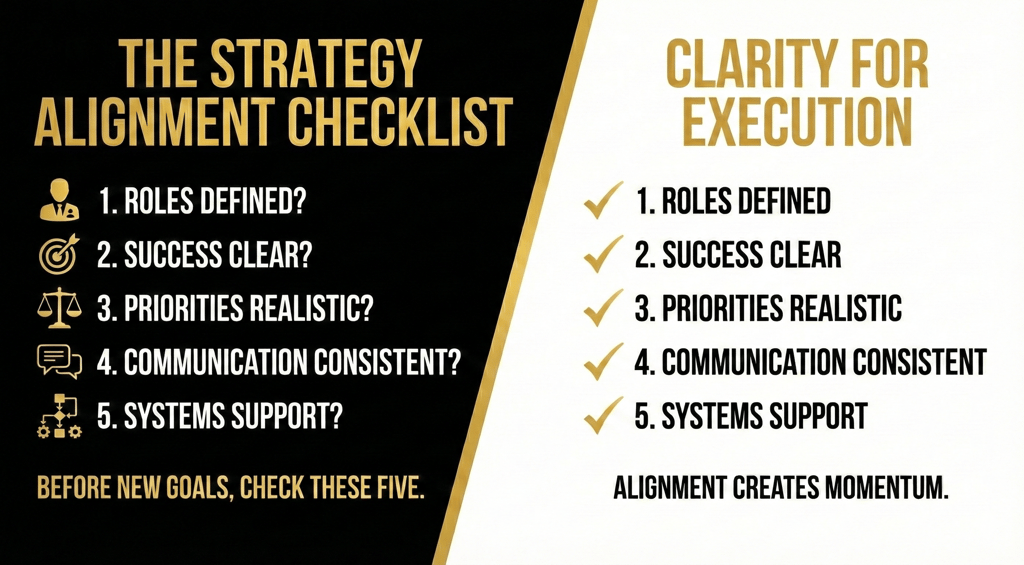
Run your organization through this 5-Point Alignment Checklist first.
1. Are Roles Clearly Defined?
The Question: Do they know where their authority begins and ends?
In many growing companies, roles are fluid. We rely on "collaboration" and "wearing many hats." But when the pressure heats up, fluidity turns into confusion. If three people think they "kind of" own a project, no one owns it.
Before setting a new goal, ask:
Does everyone know exactly what they are responsible for?
Do they know what decisions they are allowed to make without checking with you?
Are there "gray areas" where tasks are falling through the cracks?
The Fix: Ambiguity creates hesitation. Define the lane. When people know their boundaries, they run faster.
2. Do People Know What Success Looks Like?
The Question: Is there a shared scoreboard?
It sounds simple, but you would be shocked at how often we ask a team, "What does winning look like?" and get five different answers.
The CEO thinks success is "Revenue."
Sales thinks success is "Volume."
Operations thinks success is "Efficiency."
If you set a new goal without defining the specific outcome, your team will chase their own versions of success.
The Fix: Paint the picture of the finish line. "Success isn't just 'doing better.' Success is achieving X number by Y date with Z quality."
3. Are Priorities Realistic for Current Capacity?
The Question: Are you setting them up to fail?
Ambition is necessary for growth, but delusion is a recipe for burnout. If your team is already working at 110% capacity just to keep the lights on, adding a massive new project without taking anything off their plate is not leadership—it’s negligence.
When priorities outstrip capacity, you don't get more done; you just get lower quality work and higher turnover.
The Fix: Be honest about the math. If you add a new priority, what are you pausing or deleting to make room for it?
4. Is Communication Consistent and Clear?
The Question: Does it reduce noise or add to it?
In the absence of information, people make up their own stories. If your communication strategy consists of a single kickoff meeting and then radio silence, your goals will die on the vine. Execution requires a "drumbeat"—a consistent rhythm of communication that keeps the goal front and center.
The Fix: Communication shouldn't be an event; it should be a habit. Does your team have a weekly rhythm where they discuss progress, or do they only hear from you when things go wrong?
5. Do Systems Support the Work or Slow It Down?
The Question: Where is the friction?
You can have the most motivated team in the world, but if they are fighting against clunky software, outdated approval processes, or lack of data, they will fail. We often see leaders demanding "more speed" while forcing their teams to run through bureaucratic mud.
The Fix: Look at your systems. Ask your team: "What is the one thing in our daily workflow that slows you down the most?" Then fix it.
Summary: Alignment Creates Speed
It is tempting to skip these questions. They feel "boring." They require hard conversations and honest assessments. It is much more fun to just set the big goal and yell "Go!"
But strong teams pause to ask different questions.
If you can answer "Yes" to these five questions, your goals will stop feeling heavy. Execution will feel calmer. Progress will become sustainable.
Most breakdowns aren't about motivation. They are about alignment.
Your Action Plan for the Week
Before you launch your next quarter:
Print the image above. Bring it to your next leadership meeting.
Score yourselves. Go through the 5 points and rate your team on a scale of 1-10 for each.
Fix the lowest score. Don't try to fix everything at once. If your "Communication" score is a 4, spend this week fixing your meeting rhythm before you worry about the other points.
Ready to Move from Chaos to Clarity?
If you looked at that checklist and realized your foundation isn't as solid as you thought, we can help.
1. Download the FREE OD Mini-Map If you want to diagnose exactly where your structure is breaking down, download our free toolkit. The OD Mini-Map breaks organizational development into clear, practical steps so you can diagnose what’s really happening and take action with confidence.
2. Book a Free Consultation At The Mind Lab, we help business owners and CEOs build the alignment, culture, and sales strategies that create sustainable growth. Let’s look at your "5 Things" together.