
Stop Trying to Meditate Away Bad Systems: Why Impostor Syndrome is Actually a Structural Problem
Feeling isolated, overwhelmed, and like a fraud as a business owner? It might not be a psychological flaw—it’s an operational failure. Discover why impostor syndrome is often triggered by a lack of structure, and learn how to step out of the daily chaos by extracting your business from your brain and building systems that share the load.
TML Team
4/7/20264 min read
It’s 2:00 AM, and you are staring at the ceiling again.
On paper, your business is growing. You have clients, you have revenue, and your team is expanding. Everyone on the outside thinks you are crushing it. But internally, you feel an overwhelming sense of dread. You feel isolated, stretched entirely too thin, and deep down, you are terrified that you have no idea what you are actually doing.
You feel like a fraud.
When you mention this exhaustion to other entrepreneurs, the advice is almost always psychological: “You need to work on your mindset.” “Have you tried meditating?” “You just need to join a mastermind and talk to other founders.”
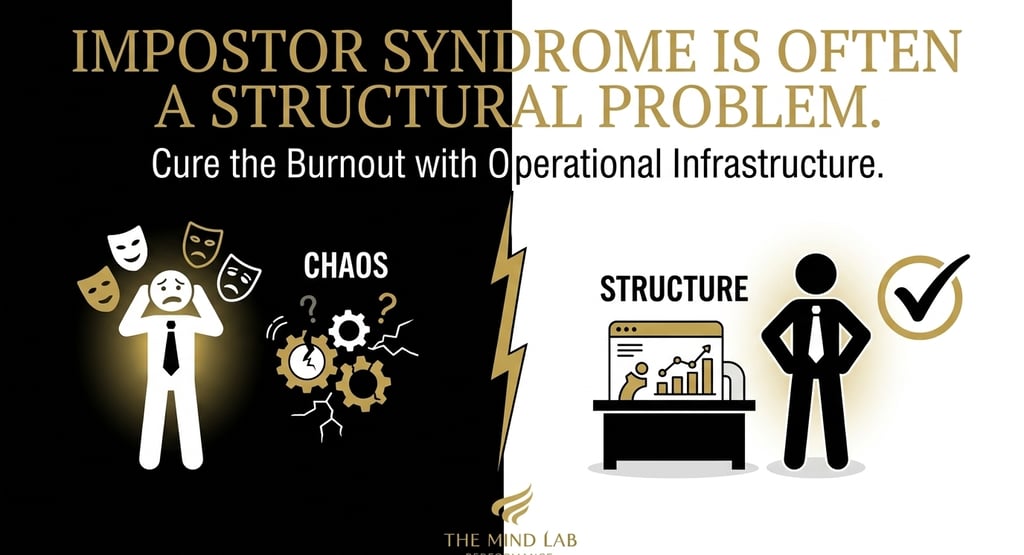
While mindset is absolutely critical to leadership, we deliver a very different hard truth to founders at The Mind Lab: Your impostor syndrome probably isn't a psychological flaw. It is an operational failure. Feeling isolated and overwhelmed as a business owner is rarely just a "mindset" issue. It happens when your business is entirely dependent on your brain. Let’s look at why your operations are secretly causing your anxiety, and how building actual infrastructure is the fastest cure for founder burnout.
The Structural Roots of Founder Isolation
When we audit businesses led by exhausted founders, we rarely find people who aren't cut out for leadership. What we find are businesses running entirely on the sheer willpower of one human being.
Here is why a lack of structure directly causes impostor syndrome:
1. The Cognitive Crushing Weight You feel like an impostor because deep down, you know the truth: if you stepped away for two weeks, the business would completely break. You are the single source of truth for how the service is delivered, how a client is handled, and how a fire is put out. No single human is designed to carry the cognitive load of an entire organization. When you hold the whole company in your head, you will inevitably feel like you are failing.
2. The Decision Fatigue Trap Because there are no clear Standard Operating Procedures (SOPs) or defined decision rights, your team doesn't know what they are allowed to do without you. So, they bring everything to you. Every minor issue, delayed project, and client question lands squarely on your desk. You aren't leading the business anymore; you are just the final filter for its daily chaos.
The CEO Who Thought They Needed to Quit
We recently worked with the founder of a highly successful creative agency. Despite doubling their revenue in a year, the founder was deeply depressed. They confessed on our first call that they felt like a terrible leader, that their team was constantly dropping the ball, and that they were seriously considering selling the agency for parts just to escape the stress.
They were convinced they lacked the "CEO mindset."
We took a look under the hood. Their mindset wasn't the problem—their systems were nonexistent. The founder was personally reviewing every single piece of creative before it went to the client. They were stepping in to rewrite copy, adjust designs, and handle billing disputes because the team’s roles were incredibly blurry.
We didn’t do a single mindset coaching session. Instead, we extracted the business from their brain.
We mapped out rigid SOPs for the client journey. We assigned singular ownership to project managers. Most importantly, we established strict decision rights—telling the team exactly what they were not allowed to ask the founder about.
Within 60 days, the founder's impostor syndrome completely vanished. Why? Because for the first time, the system was managing the business, not their willpower. The team executed beautifully because they finally had clarity, and the founder took their first unplugged vacation in three years.
How to Share the Weight
You don't need to toughen up. You need to build the infrastructure that shares the load. Here is how you start getting the business out of your head:
Action Item 1: Extract the "Founder Magic" Pick the one thing you currently believe "only you can do" (closing a specific type of deal, onboarding a VIP client, handling a refund request). Sit down and write out the exact, step-by-step process of how you do it. Turn your instinct into an instruction manual.
Action Item 2: Establish Strict Decision Boundaries Your team defaults to asking you questions as an act of self-preservation because they don't want to make a mistake. You have to give them permission to execute. Look at your direct reports and explicitly define their sandbox: "You own this project. You do not need to ask me for approval on any expense under $500, or any timeline shift under 48 hours."
Action Item 3: Define "Done" for Your Team Ambiguity breeds dependency. When you assign a project, define exactly what the measurable, final outcome looks like. When the team knows exactly how to win without your constant supervision, they will stop coming to you for daily validation.
The Bottom Line
Your exhaustion is a structural gap, not a badge of honor.
If you are feeling lonely at the top, it’s because you haven't built the scaffolding required to let others stand up there with you. When the system dictates how things run, your team can finally share the cognitive load. You stop having to "have all the answers" because the infrastructure has them for you.
Your Next Steps
Step 1: Get the Free OD Mini-Map If you are ready to stop carrying the entire weight of your business and start building the systems that share the load, you need to identify where your operations are leaking. We built a free, no-strings-attached tool to help you do exactly that. Use this framework to spot the bottlenecks, clarify roles, and streamline your daily execution. 🚀 Access the Free OD Mini-Map Here
Step 2: Let’s Talk Strategy Sometimes you are too close to the chaos to see the structural gaps. If you are exhausted, overwhelmed, and ready to get the business out of your head and into a self-managing system, let's connect. At The Mind Lab, we help founders build the operational architecture they need to step out of the weeds and actually lead. 📞 Schedule a free strategy call with our team today
Let’s trade your hustle for infrastructure.