Culture Is Not Your "Core Values" Poster: It’s How Decisions Get Made When the Building Is on Fire
Real culture isn't found in your breakroom perks—it shows up when the building is on fire. Discover why "unspoken rules" might be sabotaging your execution and how to build a culture that actually thrives under pressure.
TML Team
2/18/20265 min read
Let’s be honest for a second.
It is easy to have a "great culture" when sales are up 20%, the client is happy, and the breakroom is stocked with the good kind of sparkling water.
During the calm moments, culture feels like vibes. It feels like "we all get along." It feels like the company retreat where everyone did the trust fall and nobody got dropped.
But here is the hard truth we tell every CEO who walks through our doors: Culture rarely reveals itself during calm moments.
Real culture doesn't live in your mission statement. It doesn't live in the "Integrity" poster on the conference room wall. And it certainly doesn't live in the ping-pong table.
Real culture shows up when the server crashes at 4:55 PM on a Friday.
It shows up when the biggest client threatens to walk.
It shows up when you have to choose between hitting a revenue target and doing the right thing.
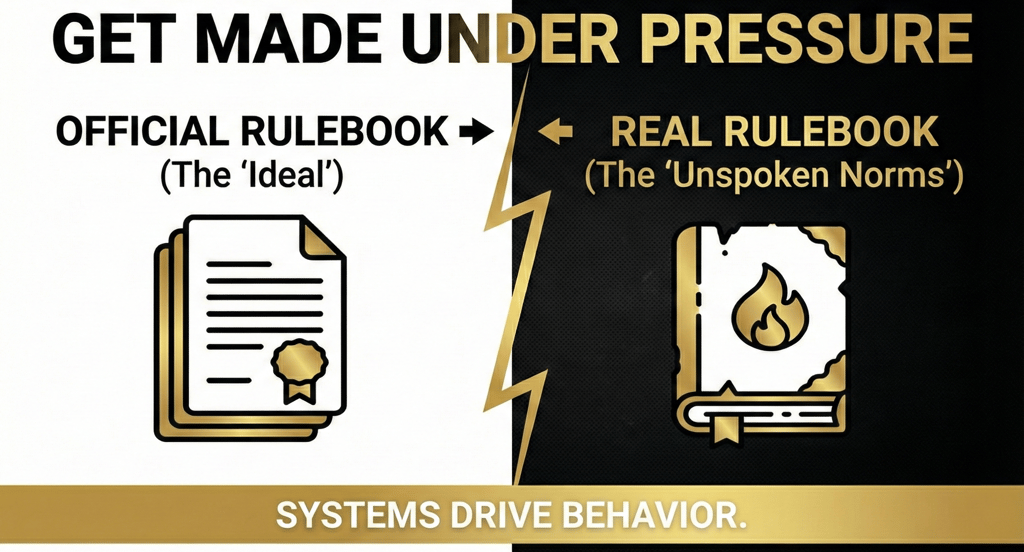
As the graphic above reminds us: Culture is how decisions get made under pressure.
If you want to know what your culture actually is, stop looking at your perks and start looking at your panic.
The "Unspoken Rules" of Your Business
Every organization has two rulebooks.
The Official Rulebook: This is your Employee Handbook. It talks about excellence, collaboration, work-life balance, and respect.
The Real Rulebook: These are the unspoken rules that guide behavior when no one is watching.
The discrepancy between these two books is where culture goes to die.
For example, your "Official Rulebook" might say you value Quality.
But let’s say a shipment is running late. The pressure is on. The stakes are high.
Does your team:
A) Delay the shipment to ensure it meets quality standards?
B) Ship it with defects just to get it off the dock and hit the quarterly number?
If the answer is B, your culture isn't "Quality." Your culture is "Speed at all costs," and your team knows it. They know that if they ship late, they get yelled at, but if they ship defects, they might get away with it.
Perks don't drive decisions. Systems and norms do.
When the pressure hits, your team doesn't turn to your value statements. They turn to the habits and decision patterns that have been reinforced over time. They look at what actually gets rewarded and what actually gets punished.
The Pain Point: Why "Good Vibes" Are Dangerous
We see a lot of leaders who are confused. They are nice people. They treat their staff well. They have unlimited PTO. Yet, their business is chaotic, deadlines are slipping, and their high performers are burning out.
They tell us, "I don't get it. We have such a good culture. Why is execution failing?"
The problem is that they are confusing Comfort with Culture.
A "comfortable" culture avoids conflict. In a comfortable culture, nobody holds anyone accountable because they don't want to "ruin the vibe."
So, when a deadline looms and trade-offs have to be made quickly, the decision-making falls apart.
Instead of prioritizing, everyone says "yes" to everything to be nice (and then fails to deliver).
Instead of addressing a bottleneck, people work around it (and burn out).
Instead of giving honest feedback, people gossip.
This is why we say culture is an operating system. It isn't just about how people feel; it's about how the machine functions when the RPMs get into the red zone. It quietly shapes behavior, influences judgment, and determines how people respond when things don't go as planned.
If your operating system is buggy, the app crashes every time you open it. It doesn't matter how pretty the icon is.
The Mind Lab Solution: Auditing Your "Crisis Culture"
If you are reading this and nodding your head (or flinching because it hits too close to home), don't panic. You can fix this. But you can't fix it with a pizza party.
You have to fix the systems that drive the decisions.
At The Mind Lab, we focus on execution over motivation. We believe that culture isn’t what you say; it’s how work actually gets done.
Here is how you move from a culture of "Vibes" to a culture of "Execution."
1. Stop Judging the Person; Judge the System
When a bad decision is made under pressure, your instinct is to blame the person. "Why did Sarah send that email without checking?"
Pause.
Ask yourself: Did the system support Sarah, or did it set her up to fail?
Was the decision-making authority clear? Did she have the data she needed? Or was she guessing because the "unspoken rule" is that asking questions makes you look stupid?
Action: When a mistake happens, ask "What in our process allowed this?" before you ask "Who did this?"
2. Define the Trade-Offs Before the Crisis
Most bad decisions happen because teams don't know what to prioritize when two values collide.
If we have to choose between Speed and Accuracy, which one wins?
If we have to choose between Profit and Customer Relationship, which one wins?
Don't wait for the crisis to decide. Tell your team the answer now.
Action: Create a "Tie-Breaker" list. explicitly state: "We prioritize accuracy over speed," or vice versa. Give them the script for the hard moments.
3. Reward the Hard Truths
If you want a culture of ownership, you have to reward people who bring you bad news.
If someone raises a red flag about a project timeline, and you roll your eyes or get angry, you have just taught the entire company a new unspoken rule: "Lie to the boss until it's too late to fix it."
Action: The next time someone brings you a problem, say, "Thank you for catching this early." Celebration of problem-detection creates a culture of problem-solving.
Your Action Plan: The "Pressure Test"
We aren't going to leave you with just theory. We focus on execution.
Here is your homework for the week. We call it the Pressure Test Audit.
Identify the last "Fire Drill": Think of the last time things went wrong in your business. A missed deadline, an angry client, a PR issue.
Analyze the Decisions: Look at the decisions your team made in that moment of heat.
Did they hide the problem or escalate it?
Did they turn on each other or swarm the problem together?
Did they default to your core values, or did they panic?
Identify the "Unspoken Rule": Based on their actions, write down what the real rule in your company is.
Example: "We say we value collaboration, but in the crisis, the unspoken rule was 'Every man for himself.'"
Rewrite the Rule: What system do you need to put in place to change that outcome next time? (e.g., A daily standup? A clear escalation protocol? A designated decision-maker?)
Conclusion: Clarity creates Calm
Culture is heavy lifting. It’s not for the faint of heart.
But when you get it right—when your spoken values match your unspoken rules—something magical happens.
The chaos fades.
The anxiety drops.
Your team stops guessing what you want them to do, and they just start doing it.
You build a team that doesn't just survive the pressure but thrives in it. That is the difference between a company that is just "growing" and a company that is scaling.
Stop hoping for a better culture. Start building the systems that force it to exist.
Ready to Fix Your "Unspoken Rules"?
If you realized during this post that your "Real Rulebook" is a mess, don't worry. We have the tools to help you rewrite it.
Step 1: Download the Free OD Mini-Map
We have created a free, step-by-step guide to help you diagnose what is really happening in your business—beyond the surface-level symptoms.
The OD Mini-Map breaks organizational development into clear, practical steps so you can take action with confidence. It is designed to help you move from overwhelm to clarity without needing complex frameworks.
👉 Download your FREE OD Mini-Map here
Step 2: Let’s Talk
Sometimes you are too close to the fire to see where the smoke is coming from. You need an outside perspective to spot the friction points and the unspoken rules you’ve become blind to. At The Mind Lab, we help business owners and CEOs build the systems, culture, and sales strategies that create sustainable growth.
👉 Contact our team for a free consultation
Let’s make this the year you stop just "growing" and start scaling.