
Big Visions Create Energy, Not Clarity: How to Build a 90-Day Execution Engine
A 10-year vision looks great on a whiteboard, but it won’t tell your team what to execute on a Tuesday morning. Discover why big ambitions often create operational chaos, and learn how to build a 90-day execution engine that turns your long-term goals into actual momentum.
3/11/20264 min read
We all know the feeling. You just wrapped up your annual planning retreat. The whiteboard is covered in sticky notes, the team is fired up, and you’ve just unveiled the massive "10-Year Vision" for the company. Everyone leaves the room feeling like they can conquer the world.
Then, Monday morning rolls around.
Your Operations Manager doesn't know which client project to prioritize. Your Sales Director is pushing a totally different agenda. And suddenly, your inbox is flooded with questions that you have to personally answer just to keep the wheels turning.
The excitement is gone, replaced by the crushing reality of Monday's to-do list.
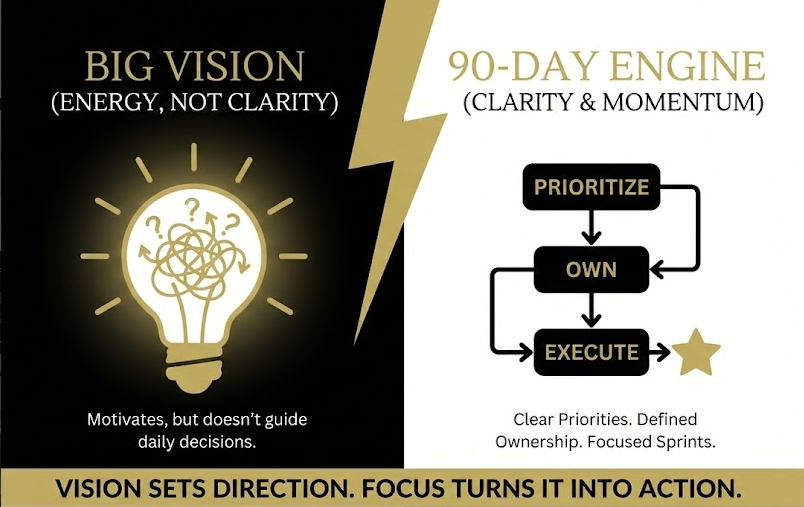
Here is the hard truth we share with our clients at The Mind Lab: Big visions create energy, not clarity.
A grand vision motivates, but it cannot guide day-to-day decisions on its own. When a company relies purely on a long-term vision without an operational bridge, teams inevitably struggle to connect their daily work to the bigger picture.
Let's break down why your team is struggling to execute your big ideas, and exactly how to fix it by building a 90-day execution engine.
Ambition Without Translation
As teams grow, leaders often feel more pressure, not less. Decisions multiply, delegation feels risky, and leaders get pulled into everything just to keep work moving.
When you feel this happening, your first instinct might be to blame your team for a lack of initiative. But hear us out: this isn’t a sign of weak leadership, and it's not a sign of a lazy team. It’s usually a sign that your systems haven’t caught up with the size and complexity of the business.
When direction is abstract, priorities compete. Because your team doesn't have clear operational guidelines on what matters today, they default to the safest option: escalating the decision to you. That is exactly how leaders become the default decision filter for the entire company.
The CEO Who Was Drowning in Potential
Last year, we worked with a rapidly scaling tech agency. The founder was a visionary—brilliant, charismatic, and full of incredible ideas for the future of the industry. He had set a goal to triple revenue in 3 years.
But inside the business? Absolute chaos.
Because every idea was deemed "critical," the team was spread paper-thin across fifteen different initiatives. They were working 60-hour weeks, but nothing was actually getting finished. The CEO was exhausted, acting as the ultimate bottleneck because his team was terrified of making the "wrong" move.
When The Mind Lab stepped in, we didn't touch his 3-year vision. We just built the track for it to run on. We forced him to pause the 15 initiatives and pick the top 3 that actually mattered for the next 12 weeks. We assigned one clear owner to each initiative, defined exactly what success looked like, and told him to step back.
The result? By week 8, they had shipped a product update that had been stalled for six months. By week 12, they hit their quarterly revenue target, and the CEO took his first uninterrupted weekend off in a year.
How to Turn Ambition into Action
Long-term goals only work when teams know what matters now. Vision sets the direction, but focus turns it into action.
Here is how you actually build that focus today:
1. Break the Vision into 90-Day Priorities Long-term goals feel inspiring but distant. You have to create short horizons to build focus and momentum.
Identify what must move in the next 90 days. Not the next year. Just the next quarter.
Limit priorities to what the team can realistically execute. If everything is a priority, nothing is.
Translate strategy into clear outcomes, not activities. Don't say "improve marketing." Say "generate 50 qualified inbound leads by June 1st."
Make trade-offs explicit. Tell your team exactly what you are not focusing on right now.
Ninety-day goals turn ambition into something teams can actually act on.
2. Establish Clear Ownership Focus fails without clear ownership. Alignment breaks when responsibility is vague. If "the team" owns a goal, nobody owns it.
Assign one owner per priority.
Clarify decision rights and expectations. Let them know what they can decide without asking you. Clear decision rights and escalation rules help leaders regain focus and help teams operate with more confidence.
Define what success looks like at the end of the sprint.
Reduce unnecessary escalation.
When you do this, ownership transforms goals from ideas into shared commitments.
3. Let Clarity Compound Small, focused sprints outperform vague long-term plans. Vision provides direction, but a ninety-day focus creates execution. When you establish clear ownership, it sustains momentum.
You don't need to work harder. You just need to shorten your timeline and clarify your expectations.
Your Next Steps
Step 1: The 90-Day Operational Reset If you are tired of acting as the "Chief Fixing Officer" for every project in your business, it’s time to rebuild your systems. We’ve designed a high-touch, 12-week consulting engagement specifically for founders who need to get out of the weeds. We will X-ray your business, align your team, and rebuild your operations into a self-managing machine.
Learn more and apply for the 90-Day Reset here (Limited to 5 founders per quarter).
Step 2: Let’s Talk Strategy If you’re feeling stretched and want support thinking through these challenges, our team offers free consultations to help you identify where structure can relieve pressure and improve execution. Sometimes, you just need an outside perspective to spot the friction points you’ve become blind to.
Schedule your free consultation with our team
Stop trying to hustle your way to a 10-year vision. Build the 90-day machine that actually gets you there.